 Home Home
Item 3:Coulomb´s law states that the electric field of a point charge is depending on distance according to 1/r2. Based on this law the field of charged objects can be calculated and it follows that in practically all cases the static electric field around such objects is also depending on distance. 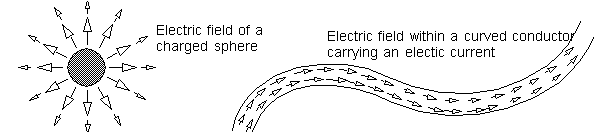
In a uniform curvilinear resistive wire of constant diameter, which carries an electric current, the electric field within the wire, which is driving the current, is NOT depending on distance. It is constant and always directed parallel to the axis of the wire, whatever be the curvature of its bending. This seems to be in contradiction with the fact, stated above, that the electric field around a charged object is depending on distance. Which of the following answers makes sense to you?
|
 next question